News
High Nature Value farming Awards: winners
12 October 2025
Celebrating nature-friendly farming in Teesdale and Swaledale
The North Pennines National Landscape team and the Yorkshire Dales National Park Authority are delighted to announce the farms that have been awarded the Tees-Swale: naturally connected High Nature Value Farming Awards for 2025.
The High Nature Value Farming Awards celebrate those farmers in the region who represent a wider field of excellence and are using nature-friendly practices to enhance the area for the future. There are two award categories: high nature value best practice and nature recovery, with the gold winning farms receiving a prize of £500 each, funded by The National Lottery Heritage Fund.
High Nature Value Farming Award
This award highlights farms which have consistently shown best practice in looking after the land, and protecting important habitats and species.
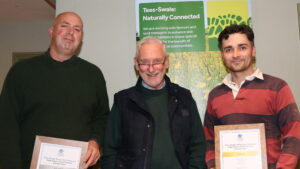
Richard Wearmouth, Middle End Farm is the High Nature Value Farming Award gold winner, recognising long-term low intensity management, protecting nature and the natural environment.
Richard grew up at Middle End and moved back in 2001 to take over the tenancy of the farm. The farm includes areas of fell grazing as well as meadows, pastures and allotments. The hay meadows contain a diversity of species; pastures and allotments are used by breeding waders and Richard has created additional habitats by making wader scrapes in several areas. It is all managed with a low intensity stocking of grazing animals. Black grouse are seen across much of the farm. In addition to these habitats Richard has also collaborated positively to reduce pollution from old mine spoils at Great Eggleshope.
Mark Watson, Aukside Villa wins the silver award for the long-term management of species rich hay meadows and areas of woodland and scrub.
Mark Watson has been at Aukside all his life. The farm is a patchwork of species rich meadows, upland pastures and areas of woodland and scrub. The farm previously had a small herd of cattle but grazing is now carried out by neighbouring farmers. The meadows are sensitively managed and species that have been re-introduced as plug plants are thriving. Bracken has been controlled on banks and extra tree and scrub planting to extend these areas of habitat and provide winter shelter and food for species such as black grouse.
Nature Recovery
The Nature Recovery category, recognises farms that have transformed the way they are managed, turning them into a place where nature has a chance to thrive.
Edwin Wood, Woodside Farm wins the gold award winner in the Nature Recovery category for his commitment to restoring field boundaries on the farm and enhance other areas for wildlife.
Since taking over the tenancy of Woodside Farm, Edwin has been working to restore farm and field hedgerows and create wildlife friendly habitats. Over 1km of hedgerows have been planted and further mature lengths laid to reinvigorate growth and provide more cover. Lengths of dry stone wall have been rebuilt and wildlife boxes installed. Other areas of scattered tree planting have also been completed. Edwin has worked closely with the North Pennines National Landscape’s Tees-Swale: naturally connected and Farming in Protected Landscapes programmes.
Liz Sutcliffe, Heggs Farm wins the silver award, in recognition of her wide-ranging work towards nature recovery on her land.
Liz moved to Arkengarthdale six years ago and has been enhancing the area for nature since then. A large scale tree planting project was carried out early on. Liz has been active in ensuring the tree planting has been successful by checking and replacing tree guards and removing them once trees are established. Areas of wetlands and scrapes have been created to provide more habitat diversity, meadows have been enhanced and bracken controlled. Liz has also engaged with the public both in collaboration with the Yorkshire Dales National Park Authority and by providing areas for camping and a bothy, both of which allow people to experience the wildlife that is now present.
About The National Lottery Heritage Fund
As the largest dedicated funder of the UK’s heritage, The National Lottery Heritage Fund’s vision is for heritage to be valued, cared for and sustained for everyone, now and in the future as set out in our strategic plan, Heritage 2033.
Over the next ten years, the Heritage Fund aims to invest £3.6billion raised for good causes by National Lottery players to bring about benefits for people, places and the natural environment.
The Heritage Fund helps protect, transform and share the things from the past that people care about, from popular museums and historic places, our natural environment and fragile species, to the languages and cultural traditions that celebrate who we are.
The Heritage Fund is passionate about heritage and committed to driving innovation and collaboration to make a positive difference to people’s lives today, while leaving a lasting legacy for future generations to enjoy.
Follow @HeritageFundUK on Twitter, Facebook and Instagram and use #NationalLottery #HeritageFund www.heritagefund.org.uk.
The North Pennines National Landscape is one of England’s most special places – a peaceful, unspoilt landscape with a rich history and vibrant natural beauty. It was designated as an Area of Outstanding Natural Beauty (AONB) in 1988. The purpose of this nationally recognised designation is the conservation and enhancement of the natural beauty of the area.
At almost 2,000 sq. kilometres the North Pennines is the second largest of the 46 National Landscapes (in England, Wales and Northern Ireland) and is one of the most peaceful and unspoilt places in England. Visit www.landscapesforlife.org.uk for information about the National Landscapes family.
The North Pennines lies between the National Parks of the Lake District, the Yorkshire Dales, and Northumberland with the urban centres of County Durham away to the east. Parts of the National Landscape are within the boundaries of four local authorities; Cumberland Council, Durham County Council, Northumberland County Council, and Westmorland & Furness Council.
The North Pennines National Landscape Partnership is an alliance of public, statutory and voluntary sector bodies with an interest in the future of the North Pennines. The work of the Partnership is carried out by the National Landscape team which takes action to conserve and enhance the natural beauty of the area, to raise awareness of its special qualities and to improve the quality of life for local people.
UNESCO Global Geopark – As well as being a National Landscape, the North Pennines is a UNESCO Global Geopark. This puts the area’s Geopark status in the same UNESCO family as World Heritage Sites and Biosphere Reserves. UNESCO Global Geoparks are places with outstanding geology where special effort is made to make the most of geological heritage to support community and economy. Locally this includes producing geo-trails, developing projects with school and community groups, producing displays for visitor attractions and holding geology festivals and events.
The Yorkshire Dales National Park is one of 15 National Parks in the UK. It is administered by the Yorkshire Dales National Park Authority, which has two main purposes: “to conserve and enhance the natural beauty, wildlife and cultural heritage” and “to promote opportunities for the understanding and enjoyment of the special qualities of the National Park”. In carrying out these purposes, the Authority has a duty “to seek to foster the economic and social well-being of local communities”. The National Park Authority comprises 25 members, made up of county and district councillors and members appointed by the Secretary of State for the Environment to represent parishes or in recognition of their specialist skills or knowledge.
Tees-Swale: naturally connected – The North Pennines National Landscape team and the Yorkshire Dales National Park Authority are working with partner organisations to deliver a major natural heritage programme that focuses on the landscape and communities of Upper Teesdale and Swaledale. Tees-Swale: naturally connected covers 829 square kilometres of Teesdale in the North Pennines National Landscape and Swaledale in the Yorkshire Dales National Park. Inspired by the report ‘Making Space for Nature’, the programme aims to restore, expand, and connect habitats across the uplands of Teesdale and Swaledale, showcasing how public funds can enhance wildlife and deliver multiple public benefits. The ethos of the programme is to work closely and in partnership with farmers, landowners and conservation agencies from the outset. In so doing, we will build the relationships and establish the skills required to sustain our High Nature Value farming systems.
High Nature Value farming is a term used to describe low intensity farming systems that are particularly valuable for wildlife, the environment, and people. The concept of knowledge exchange will be a core principle of the programme, with farmers encouraged to share their land management skills and experience, in order to target habitat improvement and restoration, in a way that allows the whole farm to work as a system.
The Tees-Swale programme area contains many areas of nationally important habitats such as Upland Hay Meadows and rush pastures supporting upland breeding wader populations. The maintenance of these habitats is often underpinned by ongoing sensitive management as part of a High Nature Value farming system. Valuing this way of managing habitats is an important part of ensuring continued positive management into the future. Without a continuation and expansion of High Nature Value farming there is likely to be degradation and loss of important habitats and species. The awards are to promote High Nature Value farming systems and recognise good practice within upland farming, showcasing farms and farmers within the project area who are delivering excellent environmental outcomes and public goods as part of their farming enterprise.
Through an innovative programme of interpretation, activities, and rights of way improvements, we will enable people to discover, explore and enjoy the stunning landscape of Teesdale and Swaledale. At the heart of this will be a drive to reveal to visitors how this landscape is managed and why this is relevant to them. Opportunities will include on-farm activities and community-led environmental art. A comprehensive learning programme will see skills developed through traineeships, knowledge-exchange schemes, and volunteering with the aim of building resilience within farming communities and empowering a future rural workforce.